
Introduction
Water quality check karte waqt aapne “TDS” word bahut baar suna hoga. RO plants, water purifiers, borewell water aur drinking water discussions me TDS ek important factor hota hai.
Bahut log confuse hote hain:
- Low TDS water better hota hai ya high TDS?
- Ideal TDS kitna hona chahiye?
- High TDS water harmful hota hai?
- Kya very low TDS water bhi problem create kar sakta hai?
Is blog me hum simple language me Low TDS aur High TDS water ka difference samjhenge.
TDS Kya Hota Hai?
TDS ka full form hota hai:
Total Dissolved Solids
Iska matlab water me dissolved minerals, salts aur impurities ki total quantity hoti hai.
TDS me commonly ye substances include hote hain:
- calcium
- magnesium
- sodium
- chloride
- bicarbonates
- salts
- minerals
TDS generally PPM (Parts Per Million) me measure kiya jata hai.
Low TDS Water Kya Hota Hai?
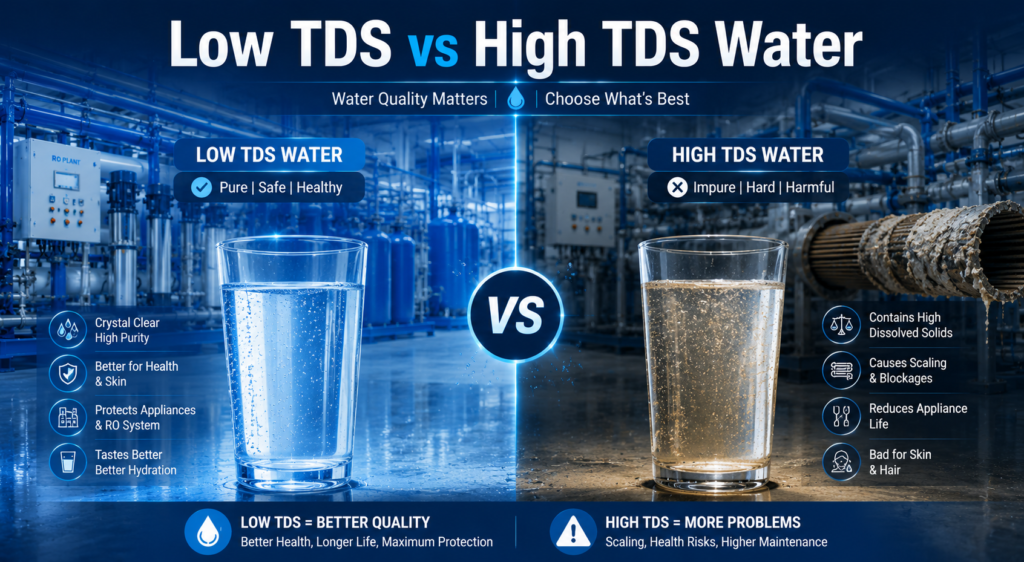
Low TDS water me dissolved solids ki quantity kam hoti hai.
Generally:
- RO water
- distilled water
- demineralized water
low TDS category me aate hain.
Low TDS water:
- soft taste de sakta hai
- less mineral content rakhta hai
- scaling reduce karta hai
Lekin extremely low TDS water har application ke liye ideal nahi hota.
High TDS Water Kya Hota Hai?
High TDS water me dissolved minerals aur salts ki quantity zyada hoti hai.
Ye commonly:
- borewell water
- hard water
- untreated groundwater
me dekha jata hai.
High TDS water:
- salty ya bitter taste de sakta hai
- scaling create kar sakta hai
- industrial equipment ko affect kar sakta hai
1. Taste Difference
Low TDS Water
- light aur neutral taste
- smooth feel
High TDS Water
- salty
- metallic
- bitter taste
de sakta hai depending on dissolved minerals.
Taste directly mineral composition par depend karta hai.
2. Mineral Content Difference
Low TDS water me minerals kam hote hain.
High TDS water me:
- calcium
- magnesium
- salts
zyada quantity me ho sakte hain.
Balanced mineral level drinking water ke liye important hota hai.
3. Scaling Problem
High TDS water:
- pipelines me scale bana sakta hai
- geyser damage kar sakta hai
- RO membranes choke kar sakta hai
- boiler efficiency reduce kar sakta hai
Low TDS water:
- scaling risk reduce karta hai
Isi wajah se industries me TDS control important hota hai.
4. Industrial Applications Me Difference
Low TDS Water Use Hota Hai:
- RO systems
- pharmaceutical industry
- laboratories
- boilers
- electronics manufacturing
High TDS Water Problem Create Kar Sakta Hai:
- scaling
- corrosion
- maintenance increase
- membrane fouling
Industrial systems generally controlled TDS water prefer karte hain.
5. Drinking Water Perspective
Bahut low TDS aur bahut high TDS dono ideal nahi maane jaate.
Extremely high TDS:
- unpleasant taste
- excessive salts
- scaling
cause kar sakta hai.
Extremely low TDS:
- flat taste
- low mineral content
de sakta hai.
Balanced TDS drinking water ke liye better hota hai.
6. RO Plant Ka Role
RO systems high TDS water ko treat karne ke liye use kiye jaate hain.
RO process:
- dissolved salts reduce karta hai
- hardness kam karta hai
- impurities remove karta hai
High TDS borewell water treatment me RO bahut commonly use hota hai.
7. Equipment Life Par Effect
High TDS water:
- equipment scaling
- pipe blockage
- membrane fouling
- maintenance increase
cause kar sakta hai.
Low TDS treated water:
- equipment efficiency improve karta hai
- maintenance reduce karta hai
- system life increase karta hai
Industrial plants me ye factor bahut important hota hai.
8. Water Softness & Hardness
Generally:
- low TDS water softer feel de sakta hai
- high TDS water harder ho sakta hai
Lekin hardness aur TDS exactly same cheez nahi hote.
Hardness mainly calcium aur magnesium levels par depend karti hai.
9. TDS Measurement Kaise Hota Hai?
TDS meter use karke water ka TDS easily measure kiya jata hai.
TDS meter:
- quick reading deta hai
- portable hota hai
- water quality monitoring me useful hota hai
RO plants aur industries me regular TDS monitoring important hoti hai.
10. Ideal TDS Kitna Hona Chahiye?
Ideal TDS completely application par depend karta hai.
Drinking Water
Moderate balanced TDS preferred hota hai.
Industrial Use
Application-specific TDS requirement hoti hai.
Boiler & Pharma
Very low TDS required ho sakta hai.
Isi liye “ideal TDS” har use case me different hota hai.
Conclusion
Low TDS aur High TDS water dono ka difference mainly dissolved minerals aur salts ki quantity par based hota hai.
Low TDS Water:
- less scaling
- soft feel
- lower mineral content
High TDS Water:
- high mineral concentration
- scaling risk
- bitter/salty taste
Water quality selection:
- application
- industry type
- drinking purpose
- equipment requirement
ke according hona chahiye.
RO systems aur proper water treatment:
- TDS control karne me help karte hain
- equipment protection provide karte hain
- water quality improve karte hain
Regular TDS monitoring better water management ke liye important hoti hai.
FAQ
Q1. TDS ka full form kya hota hai?
TDS ka full form Total Dissolved Solids hota hai.
Q2. High TDS water harmful hota hai?
Bahut high TDS water unpleasant taste aur scaling problems create kar sakta hai.
Q3. Low TDS water ka main advantage kya hai?
Low TDS water scaling reduce karta hai aur industrial equipment protection me help karta hai.
Q4. Kya RO water low TDS water hota hai?
Haan, RO systems dissolved salts reduce karte hain isliye RO water generally low TDS hota hai.
Q5. TDS kaise measure karte hain?
TDS meter ki help se water ka TDS measure kiya jata hai.
Q6. High TDS water se scaling hoti hai?
Haan, high TDS water pipelines aur equipment me scale deposits create kar sakta hai.
Q7. Kya low TDS water hamesha better hota hai?
Nahi, ideal TDS application aur drinking requirements par depend karta hai.
Q8. Industrial plants me TDS control important kyu hai?
Controlled TDS equipment efficiency improve karta hai aur maintenance reduce karta hai.
